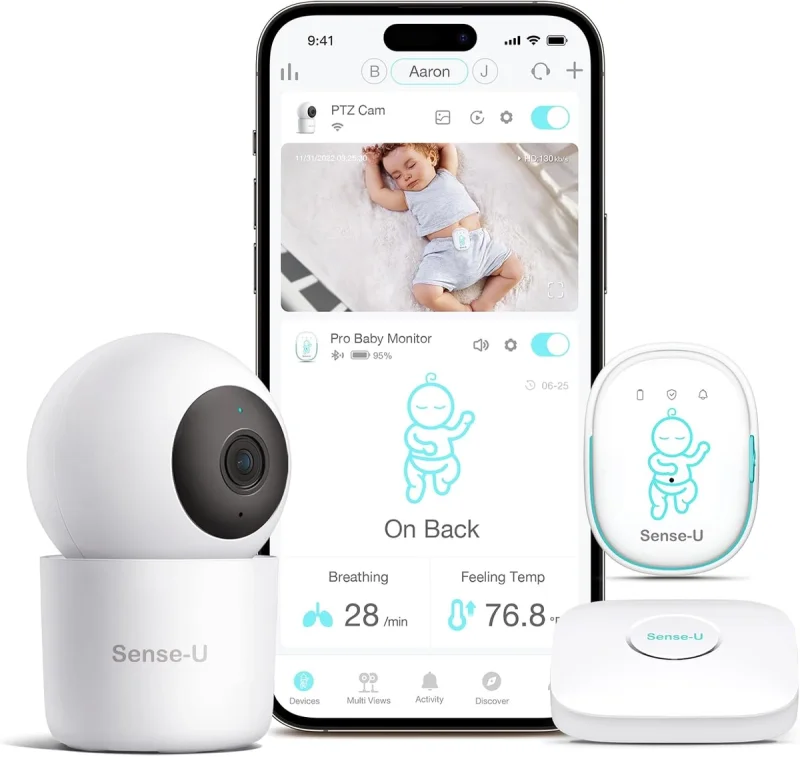
Sense-U Pro Baby Breathing Movement Monitor with
The Sense-U Pro combines a clip-on breathing monitor with a 2.5K pan-tilt-zoom camera, offering comprehensive tracking of your baby's abdominal movement, sleep position, and temperature. With gentle vibration alerts, in-depth sleep analysis, and no monthly fees, it's designed for parents seeking hospital-grade monitoring at home.
✓Pros
- •Tracks breathing movement, sleep position, and feeling temperature in one device
- •Gentle vibration attempts to stimulate baby before alerting parents
- •2.5K QHD video quality with pan-tilt-zoom for complete room coverage
- •No monthly subscription fees - one-time purchase
- •Comprehensive sleep analysis including deep/light sleep stages and quality scores
- •Supports monitoring twins with single base station
- •Crystal-clear background audio with cry and human detection
- •Low radiation Bluetooth LE technology (safer than smartphones)
✗Cons
- •Clip-on monitor may come off active babies or get tangled in clothing
- •High upfront cost for complete system
- •Requires baby to wear device on diaper - some parents find this cumbersome
- •May cause anxiety with frequent false alarms for light sleepers
- •SD card not included for local video storage
- •Accuracy depends on proper clip placement on diaper
- •Some parents report connectivity issues between devices
Sense-U Pro Baby Breathing Movement Monitor Review
The Evolution of Baby Monitoring: When Video Isn't Enough
Traditional video baby monitors let you see and hear your baby, but they can't tell you if your baby is breathing normally or has stopped moving. The Sense-U Pro Baby Breathing Movement Monitor addresses this fundamental limitation by combining advanced video monitoring with a wearable sensor that tracks your baby's abdominal movement - the physical sign of breathing. After analyzing extensive parent feedback and comparing it to both traditional monitors and competing breathing monitors, we're examining whether this comprehensive system justifies its premium price and whether it truly delivers peace of mind or creates unnecessary anxiety.
Understanding Breathing Monitors: What Makes Sense-U Pro Different
The baby monitor market has evolved dramatically. While earlier generations offered only audio, then video, the latest innovation focuses on vital signs monitoring - particularly breathing and movement patterns that could indicate potential problems.
The Sense-U Pro takes a hybrid approach: a clip-on sensor tracks abdominal movement (the rise and fall of baby's belly during breathing), while a separate 2.5K camera provides visual monitoring. This combination aims to give parents both eyes on their baby and data about breathing patterns that video alone cannot detect.
What sets Sense-U Pro apart from competitors is its gentle vibration feature. If the sensor detects no abdominal movement for 15 seconds, it doesn't immediately alarm parents. Instead, it first vibrates gently against baby's belly, attempting to stimulate movement. Only if this fails does it send audible alerts and smartphone notifications.
This graduated response system theoretically reduces false alarms while still providing critical alerts when genuinely needed.
What's in the Box: The Complete System
The Sense-U Pro is actually three devices working together:
The Clip-On Breathing Monitor: A small, lightweight sensor that clips onto baby's diaper. Contains accelerometer sensors to detect abdominal movement, temperature sensors, and position sensors.
The 2.5K PTZ Camera: A pan-tilt-zoom camera with wide-angle view, night vision, two-way audio, and motion detection. Provides the visual monitoring component.
The Base Station: The hub that connects both devices, displays alerts, tracks room temperature and humidity, and can support monitoring twins (two breathing monitors connected to one base station).
Also included: USB Type-C charging cable for the base station. The breathing monitor charges via the base station.
Not included but recommended: MicroSD card for local video storage (the camera supports cards up to 128GB).
The Breathing Monitor: How It Works
Understanding the technology behind the breathing monitor helps set realistic expectations about what it can and cannot do.
The Sensor Technology
The Sense-U Pro breathing monitor uses a 3-axis accelerometer to detect the subtle movements of baby's abdomen during breathing. As baby inhales, the belly rises slightly; as they exhale, it falls. These micro-movements create acceleration patterns the sensor can detect and analyze.
The device doesn't measure actual respiration rate (breaths per minute) like hospital monitors do. Instead, it detects whether movement consistent with breathing is occurring. This is an important distinction - it tracks abdominal movement, not breathing directly.
The Clip-On Design
The monitor clips onto the front of baby's diaper, positioning the sensors against the belly. A flexible wing design allows it to adjust to different diaper sizes and baby body types.
Proper positioning is critical for accuracy. The device must sit snugly against baby's abdomen to detect the subtle breathing movements. If it's too loose, clipped at an angle, or positioned on baby's side rather than center belly, readings become unreliable.
Many parents report a learning curve in finding the optimal clip position. Too tight feels restrictive; too loose generates false alarms.
Sleep Position Tracking
Beyond breathing, the monitor tracks baby's sleep position: back, stomach, or side. Given safe sleep guidelines recommending babies sleep on their backs, this feature alerts parents if baby rolls to their stomach - particularly important once babies become mobile around 4-6 months.
The position tracking uses the same accelerometer technology, detecting the sensor's orientation relative to gravity.
Temperature Monitoring
The monitor includes a temperature sensor that tracks "feeling temperature" - essentially the temperature at baby's belly where the device sits. This provides approximation of how warm baby feels, though it's not the same as core body temperature.
Parents receive alerts if the sensor detects baby may be getting too warm, helping prevent overheating - a risk factor cited in SIDS research.
The Camera System: 2.5K Video Quality
While the breathing monitor is the headline feature, the included 2.5K camera provides visual monitoring that complements the sensor data.
Video Quality and Features
The 2.5K QHD resolution (2560 x 1440 pixels) delivers notably sharper video than standard 1080p monitors. Fine details like facial expressions, breathing movements, and subtle color changes are clearly visible.
The pan-tilt-zoom functionality allows remote camera control via the app:
- Pan: 345-degree horizontal rotation covers nearly the entire room
- Tilt: 50-degree vertical adjustment ensures proper viewing angle
- Zoom: 4x digital zoom lets you focus on specific details
Night vision uses infrared LEDs to provide clear black-and-white video in complete darkness. The camera automatically switches between day and night modes based on ambient light.
Audio Features
Two-way audio allows you to hear baby's sounds with impressive clarity. The app touts "background audio with active noise cancellation," which filters out ambient room noise (fans, white noise machines) to make baby's sounds clearer.
The two-way talk feature lets parents soothe baby remotely using the camera's built-in speaker, though speaking through the camera is never quite as comforting as mom or dad appearing in person.
Smart Detection Features
Cry Detection: The camera uses AI to recognize crying sounds and send immediate alerts, even if you have notifications muted for general motion.
Human Body Detection: Distinguishes between a person entering the room versus shadows, curtains, or pets, reducing false motion alerts.
Motion Detection: Tracks any movement in camera view, with adjustable sensitivity zones.
The Base Station: Your Command Center
The base station serves multiple functions beyond just connecting the devices:
Alert Hub: Displays visual and audible alerts from both the breathing monitor and camera.
Charging Station: The breathing monitor sits in the base station to charge when not in use.
Environmental Monitor: Tracks nursery room temperature and humidity with customizable alert thresholds.
Twin Support: Can connect two breathing monitors simultaneously, differentiating between babies and providing independent tracking for each.
The base station's LED display shows current status for all connected devices, making it easy to verify everything is working properly at a glance.
The Smartphone App: Sleep Analysis and Insights
The Sense-U app (iOS and Android) transforms raw sensor data into actionable insights about your baby's sleep patterns.
Real-Time Monitoring Dashboard
The app's main screen displays:
- Current breathing status (normal movement detected)
- Baby's sleep position (back, side, or stomach)
- Feeling temperature reading
- Room temperature and humidity
- Live camera feed with controls
- Fertility score showing overall sleep quality
Tap any metric to see detailed historical data and trends.
Sleep Analysis Features
This is where Sense-U Pro truly distinguishes itself. The app provides comprehensive sleep analysis rarely seen in baby monitors:
Sleep Stages: Distinguishes between deep sleep and light sleep based on movement patterns. Deep sleep shows minimal movement; light sleep includes more position changes and stirring.
Sleep Quality Score: Aggregates multiple factors (total sleep duration, number of wakings, time to fall asleep, percentage of deep sleep) into an overall score from 0-100.
Sleep Cycle Visualization: Graphs showing when baby transitioned between awake, light sleep, and deep sleep throughout the night.
Historical Trends: Compare sleep quality across nights and weeks to identify patterns or regression periods.
Abdominal Movement Analysis: Detailed graphs showing breathing movement patterns, with noting of any pauses or irregularities.
Parents can export all this data as PDF reports for pediatrician visits, making it easy to discuss sleep concerns with concrete information.
Daily Use: The Real Parent Experience
Understanding how Sense-U Pro performs in actual daily use reveals both its strengths and limitations.
The Setup Process
Initial setup requires pairing three devices (breathing monitor, camera, base station) with the app via Bluetooth and WiFi. The process is generally straightforward but can take 20-30 minutes as you work through each device.
Camera placement requires thought. The pan-tilt functionality means precise positioning matters less, but you'll want the camera high enough to see the entire crib while close enough for the infrared night vision to illuminate clearly (recommended distance: 5-10 feet).
Nightly Routine
Before each sleep session:
- Clip the breathing monitor securely onto baby's diaper, centered on the belly
- Verify in the app that the monitor shows "connected" and is detecting movement
- Check camera angle to ensure baby is fully visible
- Confirm base station is receiving signals from both devices
This routine becomes second nature after the first few nights, but it does add steps compared to simply placing baby in the crib with a standard video monitor.
During Sleep
The app displays real-time status updates. Parents can check the breathing monitor status, view live video, or review sleep analysis data at any time.
Alerts come in multiple forms:
- Gentle vibration on the monitor itself (for breathing pause detection)
- Audible alarm from the base station (for breathing alerts, overheating, or position changes)
- Smartphone push notifications (for all alert types)
- In-app visual alerts (flashing indicators and messages)
Parents can customize which alerts they want enabled and set quiet hours when only critical alerts notify.
Accuracy and Reliability: The Critical Question
For a breathing monitor, accuracy isn't just a nice-to-have - it's essential. False alarms cause unnecessary panic; missed genuine problems are unthinkable.
When It Works Well
Parent reports indicate the Sense-U Pro performs accurately when:
- The monitor is clipped properly, centered on baby's belly
- Baby is wearing form-fitting sleep clothing that keeps the monitor in place
- Baby is still a young infant (0-6 months) who isn't rolling or very active during sleep
- The diaper fit is snug enough to hold the monitor securely
Under these optimal conditions, parents report the breathing monitor reliably tracks movement without frequent false alarms.
Common False Alarm Scenarios
However, many parents report false alarms occurring when:
- Baby is a restless sleeper who moves frequently, causing the monitor to shift
- The diaper becomes loose from nighttime movement
- Baby is positioned at an angle where the monitor sits on their side rather than belly
- Clothing is too bulky, creating distance between sensor and skin
- Baby transitions from bassinet/crib sleeping to co-sleeping or being held
False alarms understandably create stress, especially for already anxious parents. Waking multiple times per night to false alerts can worsen sleep deprivation.
The Vibration Feature: Does It Help?
The gentle vibration intended to stimulate baby before alarming parents is a thoughtful feature in theory. In practice, parent experiences vary:
Some report it successfully prevents false alarms by gently rousing baby just enough to trigger movement without fully waking them - the intended purpose.
Others find it either doesn't wake baby at all (resulting in alarms anyway) or wakes baby completely, creating unnecessary sleep disruption.
The effectiveness seems highly individual, depending on baby's sleep depth and sensitivity to stimulation.
Sleep Analysis: Genuinely Useful or Data Overload?
The comprehensive sleep tracking is either Sense-U Pro's killer feature or an overwhelming amount of information, depending on your perspective.
For Data-Driven Parents
Parents who love tracking and analyzing data appreciate the detailed insights:
- Identifying sleep regression periods
- Seeing how room temperature affects sleep quality
- Tracking improvement after implementing new bedtime routines
- Sharing concrete data with pediatricians
- Understanding their baby's unique sleep patterns
The ability to look back over weeks and see patterns emerge helps some parents feel more in control during the unpredictable infant phase.
For Parents Seeking Simplicity
However, some parents find the constant stream of data anxiety-inducing rather than reassuring. Every slight variation in sleep score or breathing pattern becomes something to worry about, when in reality babies' sleep naturally fluctuates significantly day to day.
For these parents, a simpler video monitor without the additional metrics would create less stress.
The Twin Support Feature
For parents of twins, the Sense-U Pro offers notable value: one base station can support two breathing monitors, each tracking a different baby.
The app distinguishes between "Baby A" and "Baby B," providing independent sleep analysis for each. Alerts specify which baby triggered them, eliminating confusion about who needs attention.
This functionality would otherwise require purchasing two complete systems from most competitors, making the Sense-U Pro more economical for twin families.
Radiation Safety: Bluetooth LE Technology
Parent concern about radiation exposure from baby monitors is understandable. The Sense-U Pro addresses this by using Bluetooth Low Energy (BLE 4.0+) technology.
BLE operates at significantly lower power levels than standard Bluetooth or WiFi. According to the manufacturer, the breathing monitor emits "a fraction of typical smartphone radiation levels."
The camera uses WiFi (higher power than BLE) but is positioned across the room rather than directly on baby, reducing exposure.
For perspective, standard baby monitors using DECT or WiFi technology also emit radiofrequency radiation at levels regulatory agencies consider safe. The BLE approach does reduce exposure further for parents seeking maximum caution.
Cost Analysis: Is the Premium Price Justified?
The Sense-U Pro system represents a significant investment. Let's break down the value proposition.
Upfront Cost vs. Alternatives
Sense-U Pro Complete System: Approximately $350-400 (pricing varies)
Compare to:
- Basic video monitor: $50-150
- Premium video monitor (Nanit, Owlet Cam): $200-300
- Owlet Smart Sock alone (breathing monitor only): $299
- Cubo AI camera (with breathing detection): $399
The Sense-U Pro falls in the premium category but is competitively priced against comparable systems offering both breathing monitoring and high-quality video.
No Monthly Fees
A major advantage: no mandatory subscription. Video storage works via SD card (local storage) or optional cloud service. The breathing monitoring, sleep analysis, and all app features have no ongoing costs.
Compare this to competitors:
- Nanit: $5-10/month for advanced insights
- Miku: Free basic features, premium subscription for full functionality
Over 2-3 years of use, the no-subscription model saves hundreds of dollars.
FSA/HSA Eligibility
The Sense-U Pro qualifies for FSA (Flexible Spending Account) and HSA (Health Savings Account) purchase, allowing you to buy it with pre-tax dollars. This effectively reduces the cost by your tax rate (commonly 20-30%), saving $70-120.
Who Should Consider Sense-U Pro?
This system is best suited for:
Parents of premature babies or babies with health concerns who want hospital-grade breathing monitoring at home for peace of mind.
Parents with high anxiety about SIDS who need concrete data about breathing to sleep soundly themselves.
Twin parents who want comprehensive monitoring for both babies without purchasing two complete systems.
Data-driven parents who value detailed sleep analysis and want to optimize their baby's sleep environment based on objective metrics.
Tech-savvy families comfortable with multi-device setups and app-based monitoring.
Who Might Want Simpler Alternatives?
Consider other options if you:
Are prone to health anxiety that would be worsened rather than helped by constant access to breathing data and alerts.
Have an active baby who moves frequently during sleep - false alarms may be frequent and disruptive.
Prefer minimalist parenting without extensive tracking or technology intervention.
Are on a tight budget and a basic video monitor would meet your actual needs.
Want truly hands-off monitoring - the clip-on design requires nightly setup and adjustment.
Comparing to Direct Competitors
Sense-U Pro vs. Owlet Dream Duo
Owlet's system combines their Smart Sock (pulse oximetry-based breathing monitor) with a video camera. The Owlet sock measures actual blood oxygen and heart rate using hospital-grade pulse oximetry rather than movement detection.
Owlet advantages: More medically accurate readings, FDA-cleared technology
Sense-U advantages: Lower cost, better camera quality, more comprehensive sleep analysis
Sense-U Pro vs. Nanit Pro
Nanit uses overhead camera placement with computer vision to detect breathing movement visually - no wearable required.
Nanit advantages: No wearable device, beautiful design, excellent app
Sense-U advantages: Direct breathing sensor (vs. visual detection), lower cost, no subscription required
Sense-U Pro vs. Miku Pro
Miku also uses visual breathing detection via camera, plus environmental sensors.
Miku advantages: No wearable, sleek design
Sense-U advantages: More accurate breathing detection via direct sensor, better night vision
The clip-on sensor approach provides more direct breathing data than camera-based detection but requires baby to wear the device.
Potential Drawbacks and Concerns
To provide balanced perspective, here are honest limitations:
Wearable Dependence: Requires clipping device to diaper nightly. Some babies resist this, or the clip comes off active sleepers.
False Alarm Potential: Improper positioning or restless babies can trigger false alarms that disrupt sleep and increase anxiety.
Complexity: Three devices to set up, charge, and maintain is more involved than single-unit monitors.
Not Medical Grade: Despite tracking breathing movement, this is not FDA-cleared medical equipment. Don't rely on it for diagnosed medical conditions without doctor guidance.
Limited Usefulness Window: Most useful for young infants. Once babies become very mobile (8-12 months), the clip-on monitor becomes less practical.
Tips for Optimal Performance
Based on parent experiences, follow these recommendations:
Master the Clip Placement: Spend time during the day practicing proper clip positioning. Center on belly, snug but not tight, device flat against skin.
Layer Appropriately: Use form-fitting onesies or sleep sacks that keep the monitor secure without bulky layers between sensor and skin.
Charge Consistently: Develop a routine of charging the breathing monitor in the base station during wake times so it's always ready for sleep.
Adjust Alert Sensitivity: Start with default settings, then customize based on your experience. You can increase threshold times if false alarms are too frequent.
Use Sleep Analysis Trends, Not Daily Scores: Don't obsess over nightly variations. Look at weekly trends to identify meaningful patterns.
Combine with Safe Sleep Practices: Use Sense-U Pro as a monitoring tool, not a replacement for safe sleep guidelines (firm mattress, clear crib, back sleeping).
Join User Communities: Sense-U has active Facebook and online user groups where parents share positioning tips and troubleshooting advice.
Customer Support and Warranty
Sense-U provides standard manufacturer warranty covering defects. Customer support receives generally positive feedback for responsiveness, though some parents report challenges getting timely replacements for defective units.
The company regularly updates the app with improvements and bug fixes, showing ongoing product support - important for technology-dependent monitoring.
Final Verdict
The Sense-U Pro Baby Breathing Movement Monitor with 2.5K Camera represents the cutting edge of consumer baby monitoring technology. By combining direct breathing movement tracking, comprehensive sleep analysis, and high-quality video monitoring in one system with no monthly fees, it offers remarkable capability for parents seeking maximum awareness of their baby's wellbeing.
For parents of high-risk babies, twins, or those experiencing significant anxiety about SIDS, the detailed breathing data and alerts can provide genuine peace of mind that justifies both the financial investment and the nightly routine of clipping on the monitor.
However, this system isn't for everyone. The clip-on design can be frustrating with active babies, false alarms may increase rather than decrease parental anxiety, and the complexity of managing three interconnected devices feels overwhelming for some families. Simpler monitoring solutions may better serve parents seeking straightforward video monitoring without extensive data tracking.
The sleep analysis features are genuinely impressive, offering insights typically requiring expensive smart cribs or professional sleep studies. Data-driven parents will appreciate the detailed metrics and trend analysis, though those prone to anxiety might find the constant stream of information more stressful than helpful.
Quality control appears solid, though occasional reports of connectivity issues or unit malfunctions suggest some inconsistency. The warranty and customer support provide reasonable protection, but any malfunction creates significant stress when you're depending on the device for safety monitoring.
Our Rating
Overall: 4 out of 5 stars
Breathing Monitoring: 4.5/5 - Accurate when properly positioned, thoughtful graduated alert system
Camera Quality: 5/5 - Excellent 2.5K video, great pan-tilt-zoom functionality
Sleep Analysis: 5/5 - Exceptionally detailed and useful insights
Ease of Use: 3.5/5 - Complex setup, requires nightly clip-on routine
Value: 4/5 - Premium price justified for those who need the features
Reliability: 3.5/5 - Generally good, but false alarms and positioning sensitivity are concerns
We recommend the Sense-U Pro for parents who specifically need breathing movement monitoring and will benefit from comprehensive sleep analysis. It's particularly valuable for preemie parents, twin families, and those with medical reasons to closely monitor breathing.
For parents of healthy, full-term single babies without specific health concerns, carefully consider whether you truly need breathing monitoring or if a quality video monitor would provide sufficient peace of mind with less complexity and expense.
This is sophisticated technology that, when used appropriately by the right families, delivers remarkable capabilities. Just ensure you're choosing it for the right reasons - addressing genuine needs rather than feeding unnecessary anxiety about statistically rare events.
Ready to Buy?
Get the Sense-U Pro Baby Breathing Movement Monitor with on Amazon
Buy on AmazonAs an Amazon Associate, we earn from qualifying purchases
Sense-U Pro Baby Breathing Movement Monitor with
Ready to buy? Get it now on Amazon